



In today’s fast-moving digital world, large companies can achieve faster, more impactful innovation by partnering with smaller, more agile businesses. These collaborations combine the market reach and infrastructure of big organisations with the specialised expertise of SMEs. Specifically, this research piece explores AI innovation and how its success rates are significantly higher when developed through partnership. Planda’s collaboration with Idox is a strong example of this, blending local authority experience and demand with sector-specific AI solutions to enhance the UK planning process.
Successful innovation demands nimbleness and strategic focus, often requiring a willingness to embrace unconventional thinking to truly transform a sector.
However, this can be challenging for larger organisations, where predictable, steady growth is often prioritised. Originality can be seen as a threat to the traditions that have enabled success, limiting the breakthrough of new concepts. As companies expand and their operations spread across multiple teams and countries, maintaining a unified strategic focus becomes complex. The obstacle, therefore, lies not in a lack of creative ideas but in transferring them effectively and efficiently into production.
On the other hand, although SMEs play a crucial role in the economy by creating jobs and driving innovation, they often struggle to gain market visibility. Moreover, scaling innovation within intricate systems, together with limited reach and reputation, can present significant obstacles to sustaining long-term growth.
So, impactful innovation should be born from creativity and flexibility, but sustaining it takes structure, stability, and scale. This is why a partnership between a large company and an SME is so powerful: each brings to the table what the other finds challenging to achieve alone.
.jpg)
SMEs offset the challenges faced by larger organisations by introducing malleability and speed. Purpose-built emerging technologies designed to address bottlenecks in existing systems can be rapidly adapted to changing circumstances, unburdened by layers of bureaucracy. Their entrepreneurial drive allows them to test, refine and deliver fresh ideas quickly. This can be harder for larger businesses bound by process, governance, or shareholder expectations. SMEs bring the agility and specialised expertise that enable big corporations to innovate faster and more effectively.
Conversely, large companies provide the foundations that many SMEs lack - not only through stability and infrastructure, but also through their experience, established governance, and deep market knowledge. These elements help transform innovation from a promising concept into a sustainable and scalable reality. Partnering with such organisations allows SMEs to access market insight and established operational frameworks, enabling them to turn innovative ideas into expandable solutions.
Together, these partnerships combine dexterity with demand. SMEs achieve market presence and access to a wide infrastructure, while larger institutions gain speed and a gateway to niche solutions. This balance of strengths creates an ideal foundation for meaningful, lasting innovation.
AI is widely recognised as essential to future business success - in fact, 94% of leaders at top corporations agree it’s fundamental to their organisation’s growth. Yet, for many large institutions, adopting and embedding AI innovation is far from simple. AI risk aversion, ethical concerns, and skills gaps often hinder progress before it begins. The result can be a cautious environment where AI incorporation is discussed more than it is delivered.
These barriers support MIT’s findings that businesses collaborating with specialised external vendors achieve roughly twice the success rate of those developing AI solutions in-house. Powerful progress happens faster when big organisations team up with agile, specialised partners who bring fresh ideas and speed.
This is precisely the formula behind the Idox and Planda collaboration - a partnership that brings together the scale, credibility and market intelligence of a long-established leader with the innovation, flexibility and AI expertise of a fast-growing SME.
With its four decades of experience supporting UK councils, Idox is the industry leader for built environment software. Their Uniform and Idox Cloud solutions power the core workflows that keep local authorities running efficiently.
Planda contributes deep AI and automation expertise, developing next-generation software for the planning sector through purpose-built technology.
Planda and Idox share a clear objective: to modernise the planning process and help councils deliver more homes. By uniting Idox’s long-standing expertise in local government systems with Planda’s AI innovation, the partnership targets one of the UK planning system’s most time-consuming yet critical stages - validation. Together, they’re streamlining workflows, freeing officer capacity, and enabling councils to accelerate housing delivery across the country.
.jpg)
For many local authorities, the validation stage is a critical point of delay, and one that is easily preventable. Officers must manually review every application to ensure compliance with national and local requirements - a necessary but highly time-consuming process that contributes to growing application backlogs.
Recognising the opportunity for innovation, Idox and Planda co-developed Ava, an AI-powered validation automation tool built specifically for local planning authorities. Ava reviews application forms, documents, and supporting materials to ensure they meet national and local validation standards. It identifies potential issues, facilitates communication with applicants, and simplifies the process of correcting invalid submissions.
What makes Ava and this partnership so valuable for officers is that it enhances their workflows without taking away control. Ava doesn’t make decisions - officers do. Every validation check, flag, and communication remains visible and under officer oversight. Ava handles repetitive administrative tasks that slow case handling, it doesn’t replace professional judgment.
Ava also integrates directly into Idox systems, so councils can continue using their existing processes within a familiar interface, with all data and updates automatically synchronised in their back-office environment.
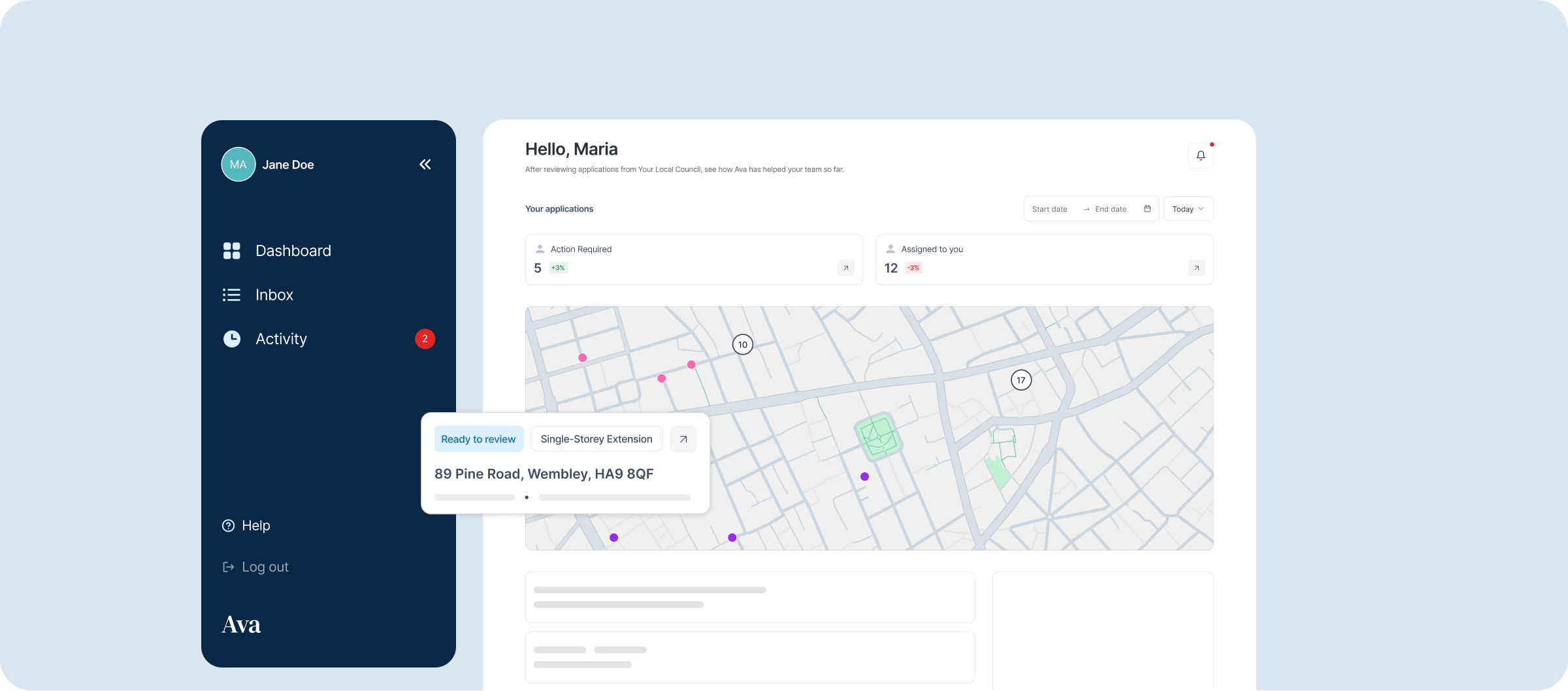
The partnership between Planda and Idox demonstrates how AI specialism and scale have united to produce a tangible, transformative tool for planning. Idox brings the credibility, infrastructure, and long-standing relationships that make local authority operations possible. Planda contributes the automation expertise and flexibility to modernise manual processes.
Ava embodies the power of that balance. It shows that when a large company’s reach and market understanding combine with an SME’s innovation and adaptability, meaningful change can happen quickly and effectively. Together, these partners have delivered a solution that enhances officer capacity, accelerates validation, and improves the speed and quality of planning outcomes.
By combining Idox’s decades of local authority experience with Planda’s AI specialism, the partnership bridges the gap between potential and performance - turning AI from a promising concept into a practical, measurable solution. This balance of trust, scale, and innovation allows both organisations to deliver real value to councils and communities.
“This partnership is about combining strengths. Planda brings cutting-edge AI capability, and Idox brings decades of experience working alongside local authorities. Together, Ava will help councils reduce invalid applications, save officer time, and improve outcomes for communities. And this is only the beginning.” - Scott Goodwin, Divisional Director, Idox
As sectors like planning become more obstructed and demands for speed and accuracy grow, collaborative partnerships between big and small companies are becoming not just beneficial but essential.
Ava answers the central question of why partnership matters for AI innovation: because together, Planda and Idox have achieved what would have been challenging for either to accomplish alone.
If you are a PLC seeking innovation, or an SME striving to gain market traction, the path forward lies in partnership. At Planda, we’re proud to be working alongside Idox to deliver AI solutions that make planning faster, smarter, and more efficient, and we invite councils across the UK to be part of that change.
If you work for a local authority or are involved in planning, learn more about Ava here or contact us here to set up a demo.


